
Why sustainable digital research matters
Last updated on 2026-07-23 | Edit this page
Estimated time: 20 minutes
Overview
Questions
- What are the net zero goals and why are they important for addressing climate change?
- How does digital research contribute to greenhouse gas emissions, and what is the scale of this contribution?
- What is mindful computing and how can it be applied to reduce carbon emissions in research?
- Why is it important for researchers to consider the environmental impact of their digital activities?
Objectives
- Explain the context of net zero goals and the distinction between carbon neutral and net zero.
- Identify the main contributors to carbon emissions in digital research infrastructure.
- Describe the concept of mindful computing and its relevance to sustainable research practices.
- Justify why researchers have a responsibility to minimize carbon emissions from their digital activities.
Environmental sustainability
Environmental sustainability refers to the need for human activity to be balanced with the long term health of the planet and availability of natural resources. There are many issues that can impact environmental sustainability:
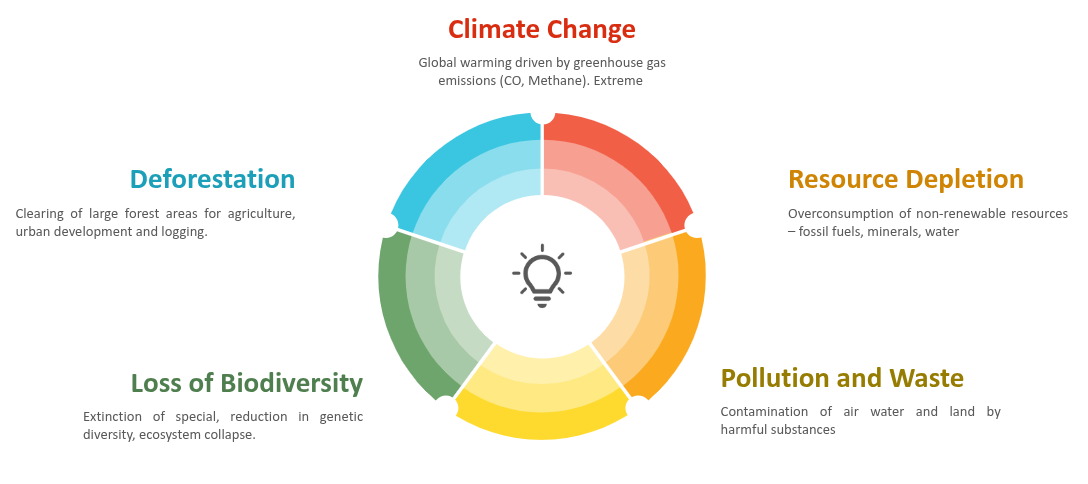
The most pressing sustainability challenge facing the world is the emission of greenhouse gases driving the climate emergency. For this reason we will primarily focus on greenhouse gas emissions, in particular we’ll focus on the metric Kilograms Carbon Dioxide Equivalent (kgCO₂e). This is a simplified metric that aims to represent the impact of a range of greenhouse gases as a single figure by expressing them as an equivalent emitted quantity of Carbon Dioxide (CO₂).
The context of net zero goals
Climate change and global warming have become pressing issues in recent years. A primary cause of these phenomena is the increase in greenhouse gas emissions in the atmosphere. Greenhouse gases (for example, carbon dioxide) are responsible for trapping heat in the Earth’s atmosphere, leading to rising global temperatures. These gases are emitted from various human activities, including the burning of fossil fuels, deforestation, and industrial processes.
To combat this, many countries, including the UK have set “net zero” goals. Net zero refers to the balance between the amount of greenhouse gases emitted and the amount removed from the atmosphere. The way to achieve net zero is by reducing emissions as much as possible and decarbonising activities. The UK plans to reach net zero by 2050.
Carbon neutral vs net zero

The terms carbon neutral and net zero are often used interchangeably, but they have different meanings. They both refer to removing harmful emissions from the atmosphere, but the kind of emissions removed and the scale are different.
Carbon neutral requires taking action to reduce carbon emissions and offsetting any remaining emissions, of a given activity. Offsetting is the process of compensating for carbon emissions by investing in projects that reduce emissions in an equivalent amount elsewhere. Usually organisations would first begin by reducing their carbon emissions as much as possible, and then offset the remaining emissions.
Net zero refers to the balance between the amount of all the greenhouse gases emitted and the amount removed from the atmosphere. Net zero uses offsets that truly absorb emissions e.g. tree planting, which is more robust as the net emissions can actually reach 0. Hence, achieving net zero has a much wider scope and requires going further than just reducing carbon emissions.
To make the audience reflect a little bit before diving into the content, run a poll with the following questions:
- What do you think the main contributors are to the emissions of
digital research? Multiple choice or open question, depending on how
close we want answers to be. If a multiple choice question, the options
could be:
- Manufacture of physical devices (laptops, servers, etc)
- Running jobs in high performance computing facilities
- Developing and running software locally in laptops and workstations
- Using AI to assist research and everyday tasks
- Using cloud resources (cloud storage, continuous integration services, etc)
- What comes to mind when thinking about mindful computing? Open question.
The role of digital research
Digital research is one of the contributors of greenhouse gas emissions and involves a wide range of activities that lead to these emissions, including:
- the use of software for data analysis, simulations and machine learning
- the storage of data
- the use of cloud computing resources
- the manufacture and provision of digital infrastructure (eg. computers, servers)
Providing these digital resources requires significant production of computer hardware and leads to significant electricity consumption, ultimately resulting in substantial carbon emissions.
The numbers in recent years show that ICT contributions to global carbon emissions were 1.3% in 2007, a revision from 2021 pointed to 4.1% and predictions for 2040 are reaching 14%.
---
config:
  xyChart:
    showDataLabel: true
---
xychart
  accTitle: {ICT contributions to global carbon emissions}
  accDescr: {1.3% in 2007, 4.1% in 2021 and predicted 14% in 2040}
  x-axis "Year" [2007, 2021, 2040]
  y-axis "ICT contributions to global carbon emissions (%)" 0 --> 15
  bar [1.3, 4.1, 14]
While digital research will always be a fraction of all of these emissions, the UKRI Net Zero DRI Scoping Project final technical report suggests a very challenging scenario in the years to come if carbon emissions are to be kept at bay with the growing demand for energy in digital-related activities in research. For the UKRI alone, the estimated carbon emissions of digital research are 75 kilotons of CO2e per year, with:
- 40 kilotons corresponding to large scale compute facilities
- 35 kilotons related to servers, laptops and small equipment.
Digital research is important for scientific progress and has the potential to contribute to solving many of the global challenges, including climate change. However, it is necessary to ensure that the carbon emissions associated with digital research are minimised. As we will learn in the following episodes, there is not a single, big carbon producer in digital research that we can eliminate without hindering the research activity, but a myriad small activities, practices, tools and processes that, while individually do not represent a big challenge, their sheer amount results in the above estimates.

As researchers, we have a responsibility to consider the environmental impact of our work and take steps to reduce it. This begins with mindful computing, a term which describes a more conscious approach to planning, running and managing digital tasks to ensure that scientific advances don’t produce more emissions than needed. Adopting this mindset could look different to everyone.
A few examples of what mindful computing could mean are:
- choosing a datacenter in a region powered by renewable energy can significantly reduce a project’s carbon footprint
- careful storage data management, where small steps such as deleting unused data or compressing data can reduce the carbon associated with long-term storage
- using incremental processing or requesting the right GPU/CPU resources when using High Performance Computing.
The purpose of this course is to explore how to measure and estimate the carbon emissions from digital research activities, what are the sources of these emissions, and what are some ways to reduce them.
References
- The UK’s plans and progress to reach net zero by 2050
- For a livable climate: Net-zero commitments must be backed by credible action
- It’s time to decarbonise digital research
- ICT currently contributes around 4.1% of global carbon emissions, with projections reaching 14% by 2040.
- Digital research in the UK alone generates an estimated 75 kilotons of CO₂e per year, split roughly equally between large-scale compute facilities and smaller devices.
- Net zero goes further than carbon neutral by targeting all greenhouse gases and requiring offsets that genuinely absorb emissions rather than merely compensating elsewhere.
- Mindful computing is a conscious approach to planning, running and managing digital tasks to ensure scientific progress does not produce more emissions than necessary.
- Researchers have a responsibility to consider the environmental impact of their digital activities and take steps to reduce them.