
Unit Testing Challenge
Last updated on 2026-05-11 | Edit this page
Estimated time: 60 minutes
Overview
Questions
- How do I apply unit tests to research code?
- How can I use unit tests to improve my code?
Objectives
- Use unit tests to fix some incorrectly-implemented scientific code
- Refactor code to make it easier to test
Introduction to your challenge
You have inherited some buggy code from a previous member of your research group: it has a unit test but it is currently failing. Your job is to refactor the code and write some extra tests in order to identify the problem, fix the code and make it more robust.
The code solves the heat equation, also known as the “Hello World” of Scientific Computing. It models transient heat conduction in a metal rod i.e. it describes the temperature at a distance from one end of the rod at a given time, according to some initial and boundary temperatures and the thermal diffusivity of the material:

The function heat() in diffusion.py
attempts to implement a step-wise numerical
approximation via a finite
difference method:
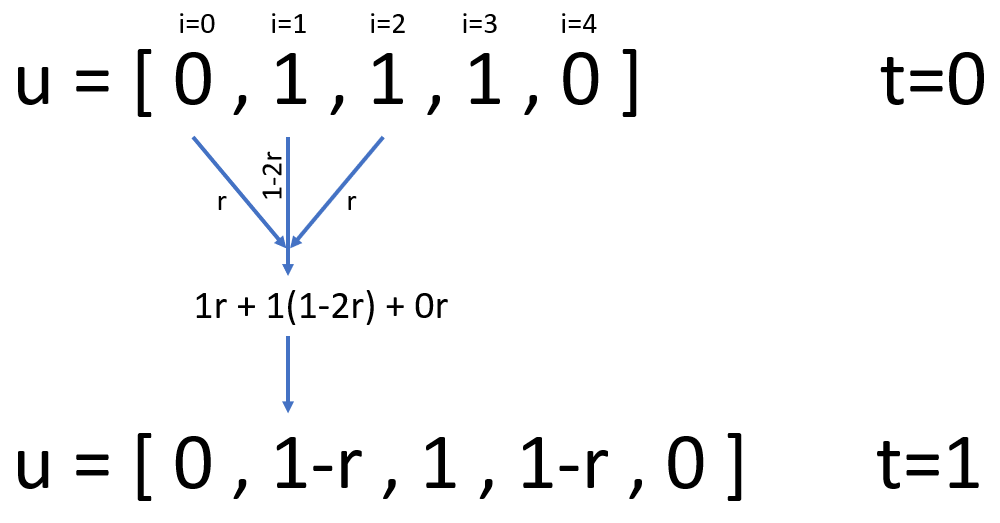
\[ u_{i}^{t+1}=ru_{i+1}^{t}+(1-2r)u_{i}^{t}+ru_{i-1}^{t} \]
This relates the temperature u at a specific location
i and time point t to the temperature at the
previous time point and neighbouring locations. r is
defined as follows, where α is the thermal diffusivity:
\[ r=\frac{\alpha \Delta t}{\Delta x^2} \]
We approach this problem by representing u as a Python
list. Elements within the list correspond to positions along the rod,
i=0 is the first element, i=1 is the second
and so on. In order to increment t we update u
in a loop. Each iteration, according to the finite difference equation
above, we calculate values for the new elements of u.
The test_heat() function in
test_diffusion.py compares this approximation with
the exact (analytical) solution for the boundary conditions
(i.e. the temperature of the end being fixed at zero). The test is
correct but failing - indicating that there is a bug in the code.
Testing (and fixing!) the code (50 min)
Work by yourself or with a partner on these test-driven development tasks. Don’t hesitate to ask a demonstrator if you get stuck!
Separation of concerns
First we’ll refactor the code, increasing its modularity. We’ll extract the code that performs a single time step into a new function that can be verified in isolation via a new unit test:
- In
diffusion.pymove the logic that updatesuwithin the loop in theheat()function to a new top-level function:
Hint: the loop in heat() should now look like
this:
- Run the existing test to ensure that it executes without any Python errors. It should still fail.
- Add a test for our new
step()function:
It should call step() with suitable values for
u (the temperatures at time t),
dx, dt and alpha. It should
assert that the resulting temperatures (i.e. at time
t+1) match those suggested by the equation above. Use
approx if necessary.
Hint: step([0, 1, 1, 0], 0.04, 0.02, 0.01) is a
suitable invocation. These values will give r=0.125. It
will return a list of the form [0, ?, ?, 0]. You’ll need to
calculate the missing values manually using the equation in order to
compare the expected and actual values.
- Assuming that this test fails, fix it by changing the code in the
step()function to match the equation - correcting the original bug. Once you’ve done this all the tests should pass.
Now we’ll add some further tests to ensure the code is more suitable for publication.
Testing for exceptions
We want the step() function to raise
an Exception
when the following stability
condition isn’t met:
\[ r\leq\frac{1}{2} \]
Add a new test test_step_unstable, similar to
test_step but that invokes step with an
alpha equal to 0.1 and expects an
Exception to be raised. Check that this test fails before
making it pass by modifying diffusion.py to raise an
Exception appropriately.
Adding parametrisation
Parametrise test_heat() to ensure the approximation is
valid for some other combinations of L and
tmax (ensuring that the stability condition remains
true).
Adding parametrisation (continued)
After completing these two steps check the coverage of your tests via the Test Output panel - it should be 100%.
The full, final versions of diffusion.py and test_diffusion.py are available on GitHub.
Bonus tasks
- Write a doctest-compatible docstring for
step()orheat() - Write at least one test for our currently untested
linspace()function- Hint: you may find inspiration in numpy’s test cases, but bear in mind that its version of linspace is more capable than ours.
- Writing unit tests can reveal issues with code that otherwise appears to run correctly
- Adding unit tests can improve software structure: isolating logical distinct code for testing often involves untangling complex structures
- pytest can be used to add simple tests for python code but also be leveraged for more complex uses like parametrising tests and adding tests to docstrings